We recently shared some questions Mary Palmer received from our clients and friends in need of a bit of landscape design advice, along with her expert advice for each question. Today, we have a few more questions to share with you, along with Mary Palmer’s suggested solutions and ideas.
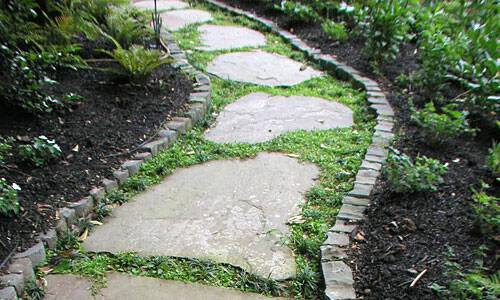
One design question? How to keep stepping stone paths weed free?PatriciaDear Patricia!Ahhh, the thousand dollar question for age old problem… The dreaded “weed between the stones dilemma.”It boils down to the path composition and if a carpet of plants is mixed between the cracks. I like the “outcompete” your neighbors approach. Plant densely with appropriate steppables and initially install with a small gravel mulch like permatil. I often use mixed sedums.Of course, hand weeding is still part of this program.The alternate weeders approach is to nuke the ne’er do wells with a blowtorch (these are excellent and come as home maintenance kits for this purpose). Alternately you could use a high concentration of acetic acid and spray.I hope this is helpful… Please send me photos and I can help further!
Happy new year!
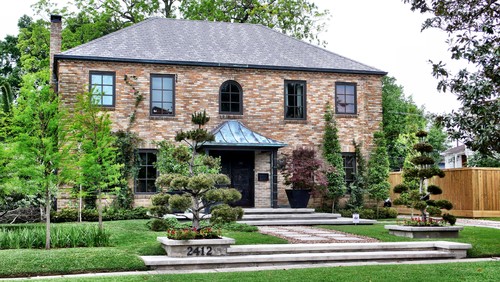
Hi Mary,When planting trees in the front yard, how do you decide where to place them?Thanks and Happy New Year,Joanna M.Dear Joanna,Front Yard Trees? Thumbs up! You are doing fantastic things for both the natural environment and your home environment.My checklist for tree planting follows. Thanks for asking!
- Why do you want to plant them: to enhance the style of the house (this leads us to type of tree to accent house), save energy expense and shade cars, to create an arboretum…choice, choices, choices!
- Choice of kind of tree: Evergreen or deciduous. Height and closeness to the house depends on the variety of the evergreen chosen.
- Orientation of House: Does your house face N-S-E-W. In both of my books and in the SPROUT blueprint system, I share a technique called the sun diagram. If your house faces south, deciduous trees are great for summer shade. So, don’t plant evergreens if you need summer sunlight in the winter.
- Personal choice…stylistic balance is frequently chosen with classically designed housing styles like georgian, antebellum, colonial revival & italianate. Asymmetrical balance is typical of cottage, custom french and modern. A great way to test your idea is to sketch ideas on a photography of your house and your ideal mental image of your house. Houses range from 25-35′ tall, and many trees are taller than this, but only after 15-25 years.
- Hmmmm, now my juices are really flowing! How about a set of flowering trees?
Feel free to contact me with a photograph!I hope this is useful,All best, Mary Palmer
What are your landscape design questions? Ask away in the comments section below!
Dargan Landscape Architects is here to help you improve your home and garden environments. Contact us to learn more about designing a master plan or tune-up for your property, or check out our PlaceMakers program!